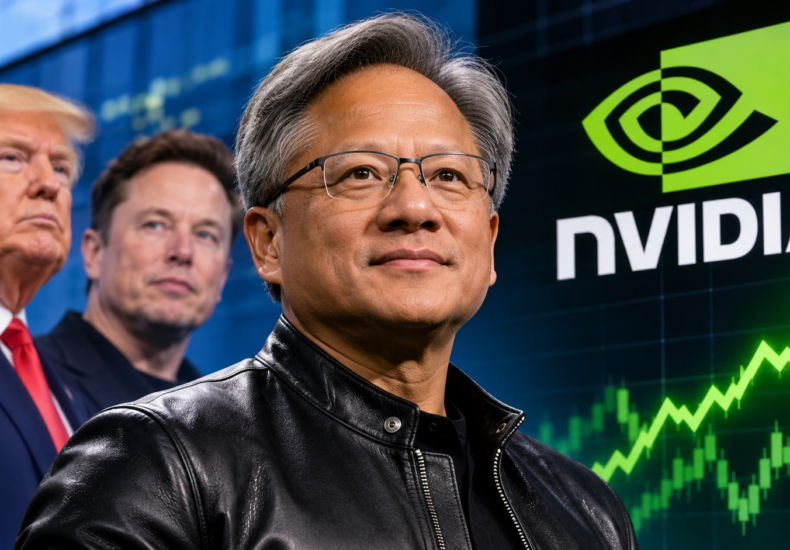
Trump and Silicon Valley Help Bring Jensen Huang Back to Nvidia
Nvidia has reinstated Jensen Huang as its chief executive following an extraordinary reversal by the company’s board, after pressure from US President Donald Trump, Elon Musk and influential figures in Silicon Valley. The decision came less than two weeks after Huang resigned, marking a significant development for the world’s leading artificial intelligence chipmaker.
The company’s board initially ruled out bringing Huang back, with Chairman Harvey Jones stating on November 17 that directors had unanimously accepted his resignation and did not intend to reinstate him. However, Nvidia announced on November 23 that Huang would return as president and CEO after receiving input from senior US government officials.
Trump publicly supported the decision, saying the US government had no reason to believe Huang’s return posed a national security risk. He also told CNBC, “I made the deal,” taking credit for helping secure the executive’s reinstatement.
In its official announcement, Nvidia said its board had unanimously approved the decision after discussions with Huang and consultations with senior government officials.
How Trump and Silicon Valley Influenced Nvidia’s Decision
The reversal followed growing pressure from prominent technology executives, investors and political figures who argued that Huang’s leadership was essential to Nvidia’s position in the global AI industry.
Tesla CEO Elon Musk publicly backed a petition calling for Huang’s return, which had attracted more than 180,000 signatures by November 16, according to Euronews. Support for the executive reflected concerns about the company’s future and the potential consequences of losing the person who had led its expansion over the previous three decades.
Trump entered the debate publicly on November 20, arguing in favor of Huang’s reinstatement. Reuters also reported that senior administration officials had been sent to pressure Nvidia’s board over the weekend before directors voted on November 22.
The company’s initial position had been considerably different. Following Huang’s resignation on November 11, Nvidia appointed Chief Financial Officer Colette Kress as interim CEO. During its November 17 earnings call, the board explicitly stated that it did not intend to reinstate him.
The board ultimately changed course after receiving government input and reassessing the circumstances surrounding Huang’s departure. Reuters’ account of the reinstatement details the pressure that preceded the decision and the market reaction that followed.
Why Jensen Huang’s Return Matters to the AI Industry
Huang’s importance extends beyond Nvidia’s corporate leadership. Over approximately three decades, he transformed the company into a central supplier of the advanced chips and infrastructure powering the global artificial intelligence expansion.
Nvidia’s position in the industry also involves financing and supporting the construction of data centers. The company has developed partnerships with major financial institutions and infrastructure investors, including BlackRock, Brookfield and Goldman Sachs, as part of initiatives supporting the expansion of computing capacity.
According to semiconductor research firm SemiAnalysis, Huang’s personal relationships and willingness to assume risks played an important role in Nvidia’s support for smaller cloud providers. The company has helped some of these businesses obtain financing for their data-center infrastructure in exchange for a share of future cloud revenue.
His influence also extended to decisions involving chip allocation, supplier relationships and access to international markets. Euronews reported that Huang maintained relationships with suppliers in South Korea and Taiwan, helping Nvidia secure critical memory and semiconductor supplies amid growing demand.
The company’s supply and capacity commitments increased from $119 billion in its fiscal second quarter to $279 billion, before reaching $390 billion in the third quarter. Nvidia attributed the latest increase primarily to multiyear memory purchases.
These developments illustrate why uncertainty surrounding Huang’s leadership became a broader concern for investors and technology companies dependent on Nvidia’s products. The company’s investor relations disclosures provide further information about its business strategy, financial performance and infrastructure commitments.
Nvidia Shares Rally as Wall Street Responds to the Reinstatement
Financial markets reacted sharply to the announcement. Nvidia shares closed 31.5% higher on Monday, adding nearly $1 trillion to the company’s market capitalization.
The rally extended across the technology sector, with the Nasdaq Composite rising 6.5% and the S&P 500 gaining 4.7%. Bloomberg estimated that Nasdaq-100 companies collectively added approximately $3 trillion in market value during the session.
The market reaction demonstrated how closely investor sentiment has become tied to Nvidia’s leadership and its role in the artificial intelligence investment cycle.
Huang’s resignation had contributed to concerns about the company’s future and the sustainability of the broader AI boom. His reinstatement helped reverse some of that uncertainty, although questions about Nvidia’s long-term business commitments and the profitability of data-center investments remained.
Economist Jason Furman of Harvard University estimated in a November analysis for the Peterson Institute for International Economics that data-center construction had increased the level of US GDP by approximately 0.3%, or 0.6% when the associated stock-market boom was included. He also estimated that the expansion had reduced the unemployment rate by approximately 0.3 percentage points.
Furman warned that a reversal in stock-market gains could put some of that economic growth at risk. The Reuters report on Nvidia’s reinstatement and the resulting market rally details the wider impact on financial markets.
National Security Concerns and Congressional Scrutiny Remain
Despite the board’s decision, Huang’s return has not resolved the questions surrounding Nvidia’s national security exposure and its international business relationships.
The controversy intensified in late October after reports by The New York Times concerning Alice Huang, a former executive at Nvidia customer Megaspeed, who was reportedly under investigation by US authorities over suspected connections to Chinese intelligence. The allegations prompted congressional scrutiny and an independent investigation by Nvidia.
Huang acknowledged being unfaithful to his wife and resigned on November 11. The circumstances surrounding his departure also raised questions about the company’s internal governance and the handling of sensitive information.
Nvidia’s board said it had received input from senior US officials and concluded that Huang’s reinstatement did not pose a national security risk. However, the company’s independent investigation remains ongoing.
Lawmakers from both parties have also criticized the decision. Democratic Senator Elizabeth Warren said Nvidia still owed Congress answers about its compliance with US export controls, while Republican Senator Pete Ricketts raised questions about national security and unaccounted-for chips.
Huang was scheduled to appear before the Senate Banking Committee on December 3 for a public hearing concerning US export controls. The House Foreign Affairs Committee was also expected to question him behind closed doors on December 1, according to Euronews.
Reuters’ reporting on concerns surrounding Nvidia’s board decision highlights the continuing debate over corporate governance, national security and the influence of government officials on private-sector decisions.
Nvidia’s Leadership Reversal Raises Broader Questions for the AI Market
Huang’s reinstatement underscores the extent to which Nvidia has become central to the artificial intelligence industry and the financial markets supporting its expansion. The company’s chips, financing arrangements and relationships with technology providers have made its leadership decisions relevant well beyond its own shareholders.
However, the episode also raises questions about corporate governance and the relationship between the US government and strategically important technology companies. While Nvidia’s board maintains that Huang’s return poses no national security risk, its investigations and congressional scrutiny remain unresolved.
For investors, the immediate market reaction demonstrated the importance attached to Huang’s leadership. The longer-term implications will depend on Nvidia’s ability to maintain its position in the AI supply chain while addressing concerns involving export controls, internal oversight and its international business relationships.
The reinstatement may have ended the immediate uncertainty over who leads Nvidia, but it has not brought the broader controversy surrounding the company to a close.
Leave a Reply