Venezuela Reveals $237.5 Billion Debt in Long-Awaited Economic Framework
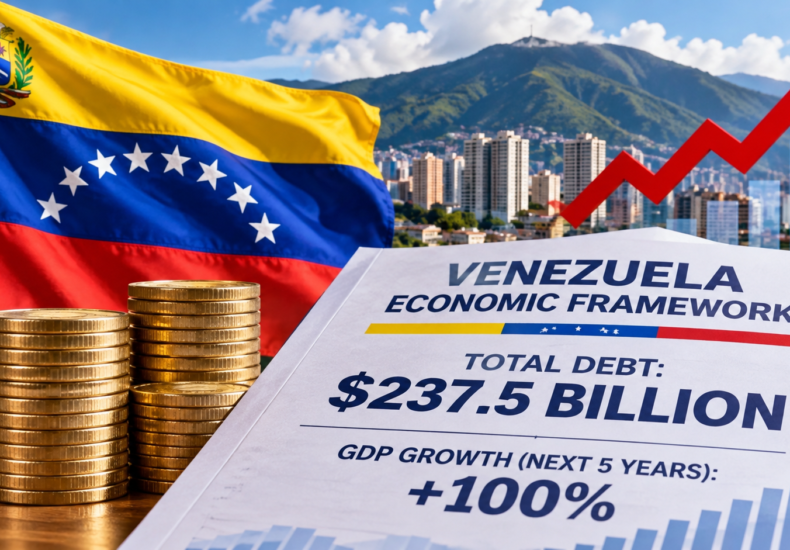
Venezuela’s government has unveiled a long-awaited economic framework that places the country’s total debt at $237.5 billion, providing its first comprehensive assessment of the economy and public finances in years. The document could serve as the foundation for one of the largest sovereign debt restructurings in history.
Published on Tuesday, November 24, the nearly 200-page report outlines the government’s economic projections, identifies the country’s financial liabilities and establishes expectations for future oil production and economic growth.
According to the framework, Venezuela expects its economic output to more than double over the next five years, reaching $200.9 billion. However, its debt burden remains substantial, equivalent to 242% of gross domestic product (GDP) at the end of 2025.
The publication marks an important step in Venezuela’s efforts to re-engage with international financial markets after years of isolation. As Reuters reported, the figures could help establish the basis for negotiations with creditors seeking repayment of outstanding obligations.
Venezuela’s Debt Reaches 242% of GDP
The government described Venezuela’s public debt as being in a state of prolonged default and financially unsustainable, citing international sanctions, declining oil revenues and years of macroeconomic imbalances.
The framework places total debt at $237.5 billion, a figure that highlights the scale of the country’s financial challenges. Of that amount, Eurobond obligations account for $110.1 billion, including $45.9 billion in overdue interest.
Venezuela has been largely excluded from international financial markets since the United States imposed financial sanctions in 2017. The restrictions, combined with years of economic deterioration, have complicated the country’s ability to refinance its obligations and negotiate with international creditors.
The government acknowledged these structural difficulties in the report, stating that the debt crisis reflects both external financial constraints and domestic economic imbalances.
Further details on the country’s sovereign debt situation and its implications for international investors are available through Reuters’ coverage of emerging markets.
Government Outlines Plan for Comprehensive Debt Restructuring
Alongside the financial assessment, Venezuela announced its intention to adopt a restructuring strategy involving all creditor groups. The government described its proposed approach as a clear and credible plan, signaling that it intends to address its outstanding obligations through a broader negotiation process.
The announcement could help ease concerns among investors that Venezuela might pursue separate agreements with individual creditor groups, potentially leaving some bondholders facing greater financial losses.
The Venezuela Creditor Committee, which represents international bondholders, declined to comment on the announcement.
The country had already announced plans to restructure its debt in May and promised to release key economic figures within a month. However, two devastating earthquakes in June further complicated efforts to assess the economy’s financial position, delaying the publication of the framework.
Venezuela’s sovereign bonds and securities issued by state-owned oil company Petróleos de Venezuela (PDVSA) rose by more than four cents on the dollar following the announcement, reflecting improved investor expectations surrounding a possible restructuring.
The reaction highlights the importance of a coordinated agreement for creditors. As the International Monetary Fund explains in its work on sovereign debt, addressing unsustainable public obligations is essential to restoring financial stability and access to international capital.
Venezuela Projects Economic Growth and Higher Oil Production
The framework also outlines ambitious economic targets, with the government expecting national output to more than double over the next five years, reaching $200.9 billion.
Oil production remains central to these projections, given the sector’s importance as a source of government revenue and foreign currency. Venezuela expects crude output to increase by an average of 9.1% annually, reaching 2.9 million barrels per day by 2036.
The target reflects the government’s expectation that a recovery in the oil industry could support broader economic expansion and improve its capacity to meet financial obligations.
However, achieving those production levels will depend on investment, infrastructure recovery and the country’s ability to overcome the restrictions that have affected its energy sector.
Venezuela holds some of the world’s largest proven oil reserves, but years of underinvestment and operational difficulties have constrained its production capacity. Additional information about the country’s petroleum industry and production outlook can be found through the U.S. Energy Information Administration’s Venezuela analysis.
International Investors Assess Venezuela’s Financial Outlook
The publication of the economic framework represents a potentially important turning point in Venezuela’s relationship with international creditors. By disclosing a comprehensive estimate of its liabilities and outlining a restructuring strategy, the government has provided investors with information needed to evaluate possible recovery scenarios.
The increase in Venezuelan sovereign and PDVSA bond prices following the announcement suggests that markets view the prospect of negotiations positively. Nevertheless, the country’s total debt, prolonged default and economic challenges mean that any restructuring process is likely to be complex.
The government’s growth projections and expectations for higher oil production could strengthen its negotiating position if they translate into sustained increases in revenue. However, investors will need to assess whether those targets are realistic and whether the country can establish the conditions necessary to attract long-term capital.
For now, Venezuela’s $237.5 billion debt estimate provides a clearer picture of the financial challenges ahead. The next major test will be whether the government can turn its economic framework into a credible restructuring agreement that restores investor confidence and supports the country’s recovery.