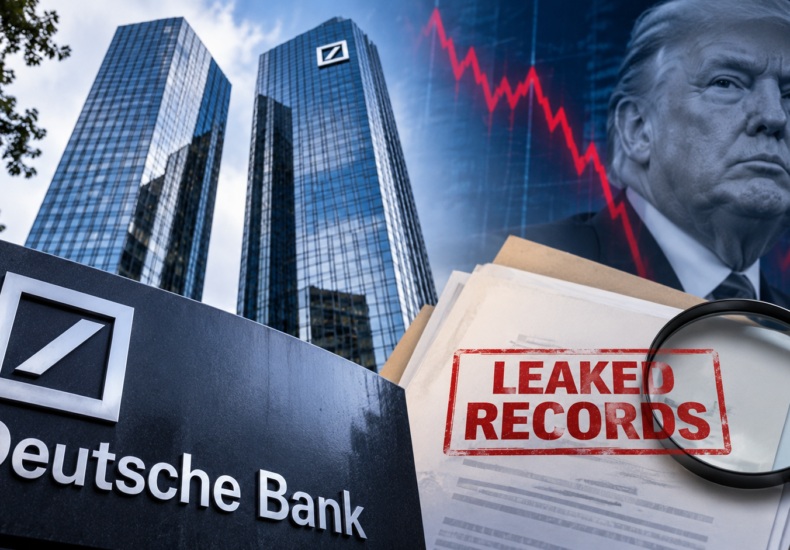
Deutsche Bank Faces Renewed Scrutiny After Leaked Records as Trump Condemns Tax Disclosure
Deutsche Bank is facing renewed scrutiny over its past business relationships after a major leak of internal records exposed details of its dealings with clients including US President Donald Trump, convicted sex offender Jeffrey Epstein and Russian oligarchs. Despite the revelations, Chairman Alexander Wynaendts publicly backed CEO Christian Sewing, while the bank’s shares fell as much as 6%.
Reports published by an international consortium of journalists examined approximately 15 million leaked records, including emails and meeting minutes. Publications involved in the investigation included Der Spiegel, the Financial Times, The New York Times and Le Monde.
Deutsche Bank said the issues described in the reports dated back many years and stressed that it had since strengthened its internal controls. The lender also said it did not expect the revelations to have a meaningful financial impact, if any.
Deutsche Bank chairman reaffirms support for CEO
Chairman Alexander Wynaendts defended Sewing, who has led Germany’s largest lender since 2018, following the publication of the reports.
“During my tenure I haven’t seen a single decision from Christian Sewing that I was not comfortable with,” Wynaendts said in a statement.
The reports renewed questions about the bank’s historical relationships with politically exposed individuals and controversial clients. They also highlighted Deutsche Bank’s efforts to expand its business in Russia before the country’s full-scale invasion of Ukraine in February 2022.
The revelations immediately affected investor sentiment. Deutsche Bank shares dropped as much as 6% on Tuesday, marking their largest decline since April 2025. They later recovered some ground but remained down 3.8% by early afternoon.
Trump calls disclosure of tax document illegal
One of the reports, published by the Financial Times, said Deutsche Bank accidentally sent a document containing Trump’s tax information to another client’s accountant in 2017.
At the time, Trump was a Deutsche Bank client during his first presidential term. Asked about the incident while in Manila, he criticized the bank for disclosing the information.
“They shouldn’t have done it. It’s illegal for them to do it,” Trump said.
Deutsche Bank declined to comment on the president’s reaction.
The incident added another dimension to the controversy, which has drawn attention to the bank’s historical handling of sensitive client information and its internal procedures.
Russian business relationships raise questions about oversight
The leaked records also revealed Deutsche Bank’s efforts to pursue business opportunities in Russia, including relationships with prominent oligarchs, until shortly before the invasion of Ukraine in February 2022.
According to the media reports, some bank managers had raised concerns about the associated risks. The revelations prompted calls for greater accountability from German and European authorities.
German Finance Minister Lars Klingbeil urged regulators to investigate the matter and take appropriate action. He also called on Deutsche Bank to explain transparently how it had addressed past weaknesses and would prevent similar problems in the future.
A member of the European Parliament also called for Sewing to appear before lawmakers to answer questions about the bank’s business practices and internal controls.
The European Central Bank and the Bank of England’s regulatory arm declined to comment.
Deutsche Bank continues efforts to rebuild its reputation
Deutsche Bank has spent years trying to restore its reputation following penalties related to anti-money laundering controls and other compliance failures.
Under Sewing, the lender has returned to profitability and reported record earnings in 2025, as well as strong results in recent quarters. However, questions about its historical client relationships have continued to resurface.
Earlier in 2026, documents released by the US Department of Justice revealed additional details about Deutsche Bank’s relationship with Epstein.
The bank said its current operations and strategy reflected significant improvements compared with its past. It also emphasized that the matters described in the latest reports were historical and that it had strengthened its controls since then.
Leaked records renew scrutiny of banking controls
The investigation was based on approximately 15 million leaked records obtained by two journalists, one from India and another from South Africa. More than 200 journalists from an international consortium examined the documents.
Reuters said it had not immediately been able to independently verify the reports.
Deutsche Bank argued that the historical nature of the issues made a significant financial impact unlikely. However, the disclosures have renewed questions about its oversight practices and the effectiveness of its efforts to rebuild public and investor confidence.
For the lender, the challenge now is to demonstrate that the controls introduced in recent years can prevent the failures associated with its past.
Leave a Reply