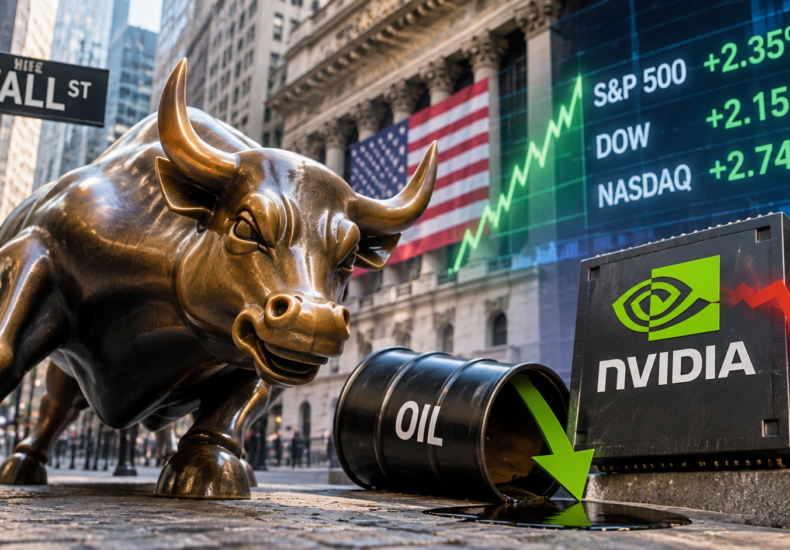
Wall Street Rallies as Oil Prices Ease Inflation Fears, While Nvidia Shares Fall
US stocks surged on Monday, November 9, as falling oil prices eased inflation concerns and helped major indexes recover from the previous week’s losses. The S&P 500 gained 2.35%, while technology shares advanced despite a sharp decline in Nvidia amid controversy surrounding CEO Jensen Huang.
All 11 major S&P 500 sectors closed higher. Industrials and consumer discretionary stocks led the gains, with both sectors rising more than 3%.
The rally followed a difficult week for US markets. Stocks had fallen after Democrats secured a sweeping victory in the midterm elections, raising concerns that new regulations could affect the artificial intelligence industry and its investment outlook.
Oil prices support broad market recovery
A sharp decline in crude oil prices helped ease concerns about inflation and supported Monday’s gains. US President Donald Trump also downplayed the possibility of renewed strikes on Iran, adding to the relief in energy markets.
The Dow Jones Industrial Average rose 1,104.02 points, or 2.15%, to 52,389.75. The S&P 500 gained 173.08 points, or 2.35%, to 7,549.94. Meanwhile, the Nasdaq Composite advanced 673.71 points, or 2.74%, to 25,253.14.
The S&P 500 recorded its largest daily percentage gain since April 8, while the Nasdaq posted its strongest advance since July 30.
Investors also looked ahead to new inflation data. The US Labor Department was scheduled to release its October Consumer Price Index on Tuesday, followed by the Producer Price Index on Friday.
Nvidia falls amid questions surrounding Jensen Huang
Nvidia shares moved in the opposite direction, falling 4.2% and closing at their lowest level since April 7. The decline came as investors reacted to reports that a foreign intelligence effort may have targeted CEO Jensen Huang.
The company was reportedly investigating the claims, raising questions among investors about Huang’s position at the world’s second-most valuable company.
Nvidia was the only declining stock in the Philadelphia Semiconductor Index, which surged 6.9% after losing more than 12% the previous week.
Other chipmakers recorded strong gains. Broadcom rose 8.8%, while Advanced Micro Devices climbed 13.3%, making them the two largest contributors to the semiconductor index’s advance.
Despite concerns about regulation, some market analysts viewed the previous week’s technology selloff as excessive. Morgan Stanley and UBS argued that the decline in AI stocks had been overdone and that the risk of severe restrictions on data center development remained limited.
Investors weigh inflation and Federal Reserve policy
Despite easing oil prices, expectations of a Federal Reserve interest rate hike in December remained above 80%, according to CME FedWatch data.
A strong October jobs report had given the central bank more room to continue raising rates. However, Richmond Federal Reserve President Tom Barkin urged policymakers to approach their next decisions carefully as they assessed inflation.
The week’s economic releases were expected to provide further clues about the direction of prices and the Fed’s next move.
KKR and energy stocks join the rally
Gains extended beyond technology companies. Investment firm KKR rose 1.7% after reporting record quarterly profit.
Constellation Energy also climbed more than 10% after its adjusted third-quarter earnings exceeded expectations. The company has exposure to the expansion of AI infrastructure and the electricity demand associated with data centers.
Market breadth reflected the strength of Monday’s session. Advancing stocks outnumbered declining ones by a ratio of 4.06 to 1 on the New York Stock Exchange and 3.34 to 1 on the Nasdaq.
The S&P 500 recorded 16 new 52-week highs and three new lows. The Nasdaq Composite registered 103 new highs and 164 new lows.
The session showed that investors were willing to return to equities as oil prices eased, even as uncertainty surrounding AI regulation, inflation and Nvidia continued to shape market sentiment.
Leave a Reply