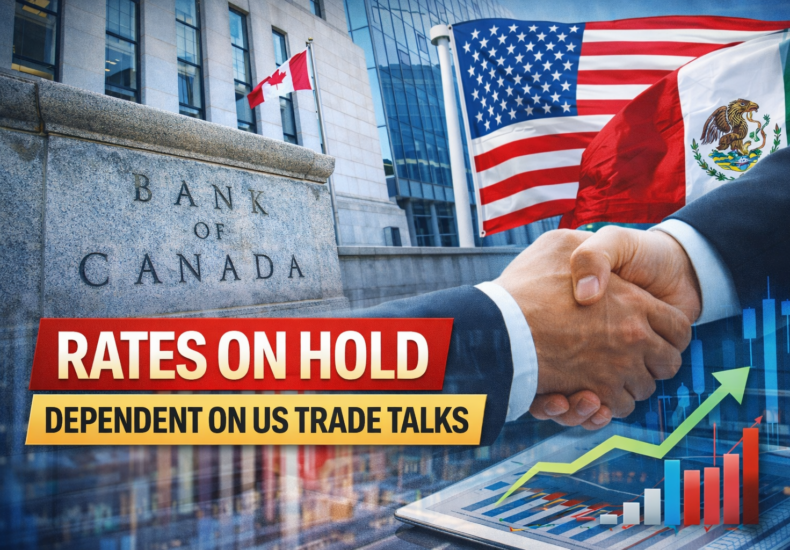
Bank of Canada Set to Hold Rates as U.S. Trade Talks Shape Future Policy
Key Highlights
- Bank of Canada expected to hold rates at 2.25%
- Nearly 75% of economists see no rate changes through 2026
- U.S.–Mexico–Canada trade talks remain the biggest risk
- Markets split between late-2026 hikes and extended pause
- Inflation stable, but business sentiment remains cautious
Introduction
The Bank of Canada is widely expected to leave its benchmark interest rate unchanged when it meets on Wednesday. Policymakers appear comfortable with current conditions. However, uncertainty around U.S. trade policy continues to cloud the outlook.
As a result, economists remain divided on where Canadian monetary policy heads next.
Why the Bank of Canada Is Standing Pat
In October, the Bank of Canada cut rates by 25 basis points. At that time, officials said policy had reached a level close to neutral. Inflation remained within the central bank’s target range.
Since then, little has changed. Consumer prices stayed stable. Economic growth remained modest. Job creation also held up through late 2025.
Because of this, policymakers see no urgent reason to move rates again.
USMCA Trade Talks Create Policy Uncertainty
However, trade risk dominates the discussion. Economists point to the upcoming review of the United States-Mexico-Canada Agreement as the biggest wildcard.
U.S. tariffs already weigh on sectors like steel, aluminum, lumber, and autos. Moreover, the Bank of Canada admits it cannot offset structural damage from trade policy.
Therefore, future rate decisions depend less on inflation and more on trade outcomes.
Economists Expect Rates to Stay Put
A recent Reuters poll shows growing consensus. Nearly 75% of economists now expect the Bank of Canada to hold rates through 2026. That share rose sharply from December.
Meanwhile, money markets show a similar view. Traders price in a long pause or mild easing through mid-2026. Only later do expectations tilt toward modest tightening.
In short, stability now dominates forecasts.
Are Canada Rates Really Neutral?
Some economists still question the current stance. Doug Porter, chief economist at BMO Capital Markets, argues rates remain too high.
Unemployment continues to rise. Trade uncertainty remains elevated. Under those conditions, neutral policy may not support growth.
Accordingly, some analysts believe further cuts could arrive if conditions worsen.
Economic Data Sends Mixed Signals
At the same time, hard data offers reassurance. Tariffs have not derailed the broader economy. Consumer spending held steady. Hiring stayed resilient into late 2025.
However, sentiment surveys tell a different story. Businesses remain cautious. Consumers worry about job security and debt.
This tension complicates the Bank of Canada’s decision-making.
What to Watch Next
The Bank of Canada will announce its decision on January 29. It will also release its quarterly Monetary Policy Report.
Importantly, the report will restore single-point forecasts for growth and inflation. It will also assess the impact of Canada’s federal budget.
Those signals may offer clearer guidance on when policy could shift.
Conclusion
For now, the Bank of Canada favors patience. Inflation sits under control. Growth continues at a modest pace.
Still, U.S. trade negotiations hold the key. Until clarity emerges on the USMCA, Canada’s central bank is likely to keep rates on hold—and flexibility high.
Leave a Reply