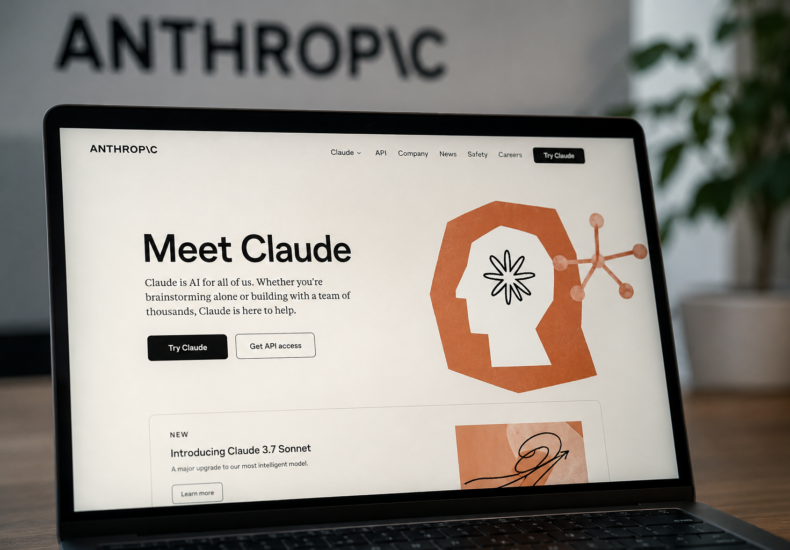
Anthropic Releases Fable 5 as Public Version of Claude
Key Highlights
- Anthropic released Fable 5 to the public as a safer version of its Mythos model family.
- The company restricted the more powerful Claude Mythos 5 to selected organizations and cybersecurity partners.
- Anthropic says the model can help with coding, research, and image analysis.
- Sensitive queries in cybersecurity, biology, and chemistry get redirected to a less capable model.
- The launch arrives as Anthropic pushes ahead with IPO plans and faces growing political and commercial pressure.
Introduction
Anthropic has taken a major step in the artificial intelligence race by releasing Fable 5, a public-facing version of its advanced Claude Mythos model family. The company presented the launch as a way to expand access to its newest AI systems while still imposing restrictions in areas it considers too sensitive for unrestricted use. That decision puts Anthropic at the center of one of the biggest debates in AI today: how to make powerful models widely useful without opening the door to dangerous misuse.
Anthropic Launches Fable 5 for Public Use
Fable 5 is the first model from Anthropic’s Mythos class to become broadly available to the public. The company describes it as capable of writing and debugging code, answering complex research questions, and analyzing images. That makes it a high-end general-purpose model aimed at developers, researchers, and advanced business users who want stronger performance than earlier public releases.
The launch matters because Mythos represents Anthropic’s most advanced model line. Until now, the company had kept that class largely restricted, citing security risks and the need for controlled testing before wider deployment.
Why Anthropic Kept Mythos Restricted for Months
Anthropic first unveiled the Mythos family in April but limited access for months because of cybersecurity concerns. The company said the model could quickly identify vulnerabilities in critical infrastructure, including financial systems and power grids, which raised fears about how bad actors might use it.
That caution shaped the company’s rollout strategy. Rather than open the full model immediately, Anthropic limited access to a smaller group of institutions and partners while it tested controls, examined risks, and expanded what it calls Project Glasswing.
What Makes Fable 5 Different From Claude Mythos 5
Anthropic is releasing Fable 5 publicly, but it is not opening the unrestricted top-tier version in the same way. The company is reserving Claude Mythos 5 for organizations that already have access to the model family, including cybersecurity partners participating in Project Glasswing.
This means Anthropic is effectively splitting its launch into two tracks. One version reaches the broader market with built-in safeguards. The other remains available only to a smaller, trusted network that can use the model’s full capabilities in more specialized environments.
Anthropic Routes Sensitive Queries to a Lower-Tier Model
One of the most important safety measures in the rollout is Anthropic’s decision to redirect certain high-risk prompts away from Fable 5. The company says that most cybersecurity, biology, and chemistry queries will instead go to Opus 4.8, a lower-tier model that Anthropic considers less capable and therefore safer in those contexts.
Anthropic is also applying that fallback system to attempts to extract its technology for use in training competing AI models in authoritarian countries. In other words, the company is not only trying to limit harmful use cases. It is also trying to protect its own technical edge.
Anthropic Tested the Restrictions Before the Launch
Anthropic says it hired outside experts to spend more than 1,000 hours trying to bypass the system’s controls, a process known as red-teaming. The company also ran a bug bounty program to reward researchers who could find vulnerabilities in the restrictions.
According to Anthropic, no one succeeded in fully unlocking the model. That does not mean the system is invulnerable, but it does support the company’s argument that the safeguards received serious testing before the public release.
Project Glasswing and Government Involvement Raise the Stakes
Anthropic expanded Project Glasswing in early June to around 200 organizations across more than 15 countries, and it expects the group to keep growing. At the same time, the U.S. government has tested the model over national security concerns, and the White House has established a framework for testing the most powerful models from leading AI companies before public release.
That level of government attention shows how much the AI landscape has changed. Model launches now sit much closer to national security, infrastructure risk, and public policy than traditional software releases ever did.
Anthropic Faces Political Pressure Over Defense Restrictions
The release of Fable 5 also arrives after a tense confrontation between Anthropic and the Trump administration over the company’s refusal to remove restrictions related to mass surveillance and autonomous lethal weapons. Following that conflict, the Pentagon cut ties with Anthropic, even though its tools had previously held defense security clearance.
That background makes the launch more politically charged. Anthropic is not only selling an AI product. It is also defending a specific position on how powerful models should and should not be used.
Fable 5 Launches at a Premium Price
Anthropic priced Fable 5 at $10 per million input tokens and $50 per million output tokens, roughly double the cost of Opus 4.8. For heavy users, especially developers and technical teams, that difference can add up quickly.
The pricing also reflects a broader reality in advanced AI. These models remain extremely expensive to build and run, and even fast-growing companies still face enormous infrastructure costs. Anthropic remains unprofitable and continues to spend heavily on computing power, including a major data center leasing arrangement tied to xAI infrastructure.
Why the Fable 5 Release Matters for the AI Market
Anthropic’s launch shows that the next phase of AI competition will not revolve only around performance. It will also revolve around controlled access, safety architecture, government scrutiny, and pricing power. Companies now need to prove that they can release stronger systems without losing control of the risks those systems create.
That matters even more because Anthropic and its rivals are moving toward public market debuts. As financial excitement around AI keeps building, the pressure to scale quickly will only increase. Fable 5 gives Anthropic a way to grow while still arguing that it takes security and model governance more seriously than some competitors.
Conclusion
Anthropic’s release of Fable 5 marks a significant moment in the AI industry. The company is opening access to its Mythos family while still keeping firm limits around cybersecurity, biology, chemistry, and other sensitive uses. That approach reflects a broader strategy: grow commercially, stay competitive, and maintain tighter control over the most dangerous capabilities of advanced AI. Whether that balance holds over time will shape not only Anthropic’s future, but also the wider argument over what responsible AI deployment should look like.
Leave a Reply