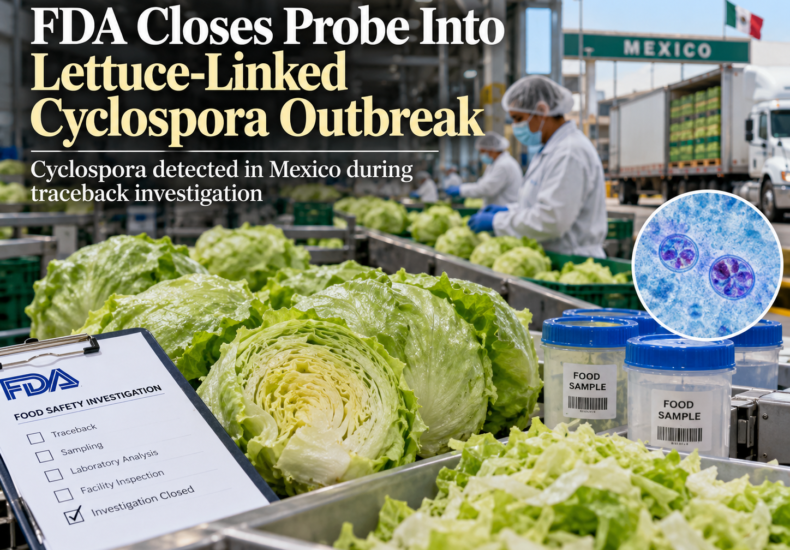
FDA Finds Cyclospora in Mexico After Lettuce Outbreak
Key Highlights
- The U.S. Food and Drug Administration has closed its investigation into a major cyclosporiasis outbreak linked to shredded iceberg lettuce grown in Mexico.
- FDA inspections found Cyclospora in two environmental samples connected to farms and processing facilities supplying Taylor Farms de Mexico.
- One positive sample came from a wastewater tank at a processing facility, while another came from a drainage ditch at an iceberg lettuce farm identified through traceback.
- At least 12,883 people across 21 U.S. states became ill, with 570 hospitalizations and two deaths.
- Taylor Farms voluntarily recalled affected products and removed all iceberg lettuce sourced from central Mexico on July 17.
- The FDA says all lettuce associated with the outbreak is now off the market.
- U.S. laboratories reported 19,883 confirmed cyclosporiasis cases between May 1 and August 31, compared with just 1,180 during the same period in 2025.
FDA Closes Investigation Into Massive Cyclospora Outbreak
The outbreak was linked to shredded iceberg lettuce supplied by Taylor Farms de Mexico.
FDA investigators conducted inspections at farms and processing facilities involved in the lettuce supply chain and collected environmental samples during the investigation.
Two samples tested positive for Cyclospora.
Although investigators were unable to determine precisely how the lettuce became contaminated, the findings strengthened the evidence connecting the outbreak to lettuce grown and processed in Mexico.
Cyclospora Detected at Two Locations in Mexico
The FDA identified two positive environmental samples during its investigation.
One came from a tank at a processing facility that contained outgoing wastewater.
The second came from a drainage ditch at an iceberg lettuce farm identified during the FDA’s traceback investigation.
The agency said the findings demonstrate that Cyclospora was present in the environment where the lettuce was produced and processed.
However, the FDA emphasized that the available evidence does not conclusively establish the precise contamination pathway.
Instead, the environmental findings were considered alongside epidemiological and traceback data.
Together, those findings supported the agency’s conclusion that shredded iceberg lettuce from Taylor Farms de Mexico was associated with the outbreak.
Nearly 13,000 People Became Ill
The scale of the outbreak was significant.
At least 12,883 people in 21 states developed cyclosporiasis.
Among those cases, 570 people were hospitalized.
Two deaths were also reported.
The outbreak began in June and was declared over on September 11.
The large number of infections contributed to an extraordinary increase in cyclosporiasis cases reported across the United States during the summer.
U.S. Cyclospora Cases Surge Dramatically
Between May 1 and August 31, the Centers for Disease Control and Prevention received reports of 19,883 laboratory-confirmed cyclosporiasis cases.
During the equivalent period in 2025, only 1,180 cases were recorded.
That represents an increase of more than 1,500 percent year over year.
Not every case reported during that period was necessarily associated with the lettuce outbreak, but the outbreak contributed substantially to the nationwide increase.
The figures demonstrate how a foodborne contamination event involving a widely distributed product can rapidly produce thousands of illnesses across multiple states.
What Is Cyclospora?
Cyclospora cayetanensis is a microscopic parasite that can cause an intestinal illness known as cyclosporiasis.
People typically become infected after consuming food or water contaminated with the parasite.
Symptoms can include prolonged or severe diarrhea, stomach cramps, bloating, nausea, fatigue and loss of appetite.
The illness can persist for an extended period without appropriate treatment.
Unlike many common foodborne pathogens, Cyclospora is a parasite rather than a bacterium or virus.
Fresh produce has been associated with previous cyclosporiasis outbreaks because contamination can occur during growing, harvesting, processing or handling.
Taylor Farms Issued Recall
Taylor Farms responded to the investigation by recalling affected products.
On July 17, the company also announced that it was voluntarily removing all iceberg lettuce sourced from central Mexico.
The action was intended to prevent additional potentially contaminated products from reaching consumers.
The FDA now says it is confident that all lettuce associated with the outbreak has been removed from the market.
That means the agency does not consider the recalled lettuce to represent an ongoing consumer exposure risk.
Why Traceback Was Important
Identifying the source of a foodborne outbreak can be difficult.
Produce can travel through complicated supply chains involving farms, processing facilities, distributors, restaurants and retailers.
Investigators therefore use traceback analysis to reconstruct where foods consumed by sick individuals originated.
In this case, traceback evidence pointed investigators toward shredded iceberg lettuce supplied by Taylor Farms de Mexico.
That analysis eventually led inspectors to farms and processing facilities in Mexico.
Environmental sampling then detected Cyclospora at two locations associated with the supply chain.
The combination of epidemiological evidence, product tracing and environmental testing strengthened the link between the lettuce and the outbreak.
FDA Could Not Determine Exactly How Contamination Occurred
Despite finding the parasite in the environment, investigators could not establish a definitive contamination mechanism.
The positive wastewater and drainage samples prove that Cyclospora was present in areas associated with lettuce production and processing.
They do not, by themselves, demonstrate exactly when or how the parasite reached the lettuce consumed by patients.
Potential contamination routes in agricultural environments can involve water, sanitation conditions, handling practices and other environmental factors.
The FDA has not identified a specific pathway in this outbreak.
That distinction matters because identifying the source environment and identifying the exact mechanism of contamination are separate investigative questions.
Mexico’s Produce Supply Chain Faces Renewed Attention
The investigation could increase scrutiny of food-safety practices surrounding fresh produce imported from Mexico.
Mexico is one of the most important suppliers of fresh vegetables and agricultural products to the United States.
Large integrated supply chains allow fresh produce grown in Mexico to reach American supermarkets and restaurants quickly.
That scale creates significant economic benefits but also means that contamination at a farm or processing facility can potentially affect consumers across many states.
The lettuce outbreak demonstrates the importance of sanitation, environmental monitoring and effective traceback systems throughout cross-border produce supply chains.
Wastewater Finding Raises Environmental Questions
One of the most notable findings was the detection of Cyclospora in a tank containing outgoing wastewater at a processing facility.
Another sample was collected from a drainage ditch at a lettuce-growing operation.
Those findings suggest the parasite was present in the broader production environment.
Because Cyclospora contamination is generally associated with fecal contamination involving humans, water management and sanitation are important areas for investigators studying outbreaks.
However, the FDA has not concluded that either positive environmental location directly contaminated the lettuce.
Further interpretation should therefore remain cautious.
Why Fresh Produce Can Be Difficult to Protect
Fresh vegetables present unique food-safety challenges.
Unlike meat and many processed foods, lettuce is often consumed raw.
There is typically no cooking step capable of destroying pathogens immediately before consumption.
Contamination that occurs during production or processing can therefore persist until the food reaches consumers.
Leafy vegetables are also handled at numerous points before reaching supermarkets, restaurants and homes.
Preventing contamination requires controls throughout the entire production chain, including water quality, worker hygiene, processing sanitation and transportation.
Hospitalizations Highlight Severity of Outbreak
Most foodborne illnesses resolve without hospitalization, making the 570 hospitalizations associated with this outbreak particularly notable.
Cyclospora infection can cause persistent gastrointestinal symptoms and dehydration.
Illness can be particularly difficult for people whose symptoms continue for extended periods.
The outbreak also resulted in two reported deaths, underscoring the potential seriousness of large foodborne disease events.
Health authorities declared the outbreak over on September 11 after the number of new infections associated with the event declined and the implicated lettuce had been removed from circulation.
What Consumers Should Know
The FDA says lettuce connected to the outbreak is no longer on the market.
Consumers therefore do not need to discard iceberg lettuce currently being sold solely because of this outbreak.
People who experience prolonged diarrhea or other significant gastrointestinal symptoms should contact a healthcare professional, particularly if symptoms persist.
Because multiple illnesses can cause similar gastrointestinal symptoms, laboratory testing may be necessary to diagnose cyclosporiasis.
Public-health agencies also rely on confirmed cases to identify patterns and detect emerging outbreaks.
What Happens After the Investigation
Closing the outbreak investigation does not eliminate the broader food-safety questions raised by the event.
The FDA’s environmental findings can help regulators and food producers identify practices that could reduce the risk of future contamination.
Taylor Farms and other producers may also use the investigation to evaluate water systems, drainage, sanitation procedures and processing controls.
The unusually large outbreak provides valuable information for understanding how Cyclospora can enter fresh-produce supply chains.
Preventing another event of similar scale will depend on translating those findings into stronger preventive controls.
Conclusion
The FDA’s investigation into the 2026 cyclosporiasis outbreak has provided strong evidence connecting the illnesses to shredded iceberg lettuce supplied by Taylor Farms de Mexico.
Inspectors detected Cyclospora in two environmental samples associated with Mexican lettuce production and processing, including wastewater at a processing facility and a drainage ditch at a grower identified through traceback.
Investigators have not determined exactly how the lettuce became contaminated.
However, the environmental results, epidemiological evidence and traceback investigation collectively support the link to the Mexican lettuce supply chain.
The scale of the outbreak was extraordinary.
At least 12,883 people became ill across 21 states, 570 were hospitalized and two died.
The broader summer surge brought U.S. laboratory-confirmed cyclosporiasis cases to nearly 20,000 between May and August, compared with fewer than 1,200 during the same period one year earlier.
With the implicated lettuce removed from the market and the outbreak officially over, attention now turns toward prevention.
The central challenge for regulators and produce companies will be determining how to reduce the risk that Cyclospora enters agricultural and processing environments and causes another large cross-border foodborne outbreak.
Leave a Reply