Mark Carney Pitches Canada as a Safe Harbour for Global Investors
Key Highlights
- Prime Minister Mark Carney is pitching Canada as a “safe harbour” for global finance during a period of geopolitical and economic uncertainty.
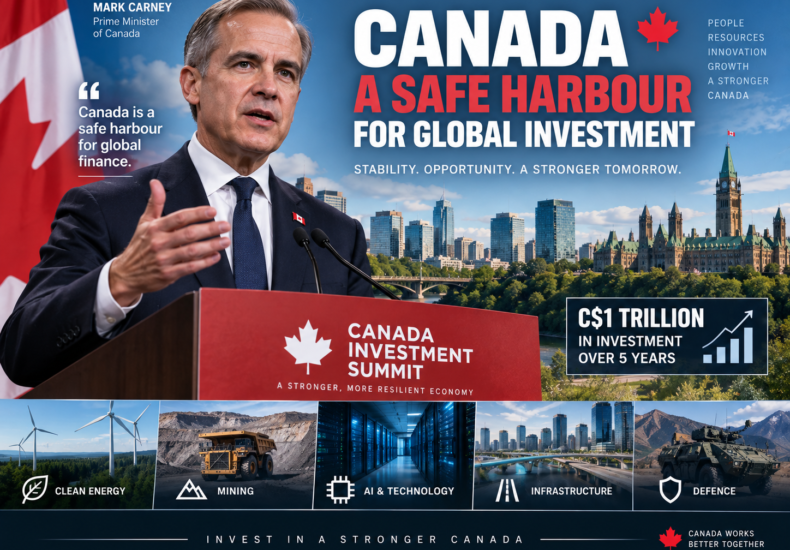
- Carney wants to attract C$1 trillion in investment over the next five years.
- Investors representing more than C$120 trillion in assets are being courted by Ottawa.
- Canada is promoting more than 160 projects, including mines, pipelines, data centres and infrastructure.
- Priority sectors include defence, energy, mining, artificial intelligence and infrastructure.
- Carney also announced plans to allow private investment in operations at four major Canadian airports.
- The strategy comes as Canada seeks to reduce its economic dependence on the United States and deepen ties with Europe, Asia and the Middle East.
Mark Carney Wants Canada to Become a Global Investment Safe Haven
His message is clear.
Canada wants to position itself as a safe harbour for global capital at a time when geopolitical tensions, trade disputes and economic uncertainty are forcing investors to reconsider where they deploy money.
Speaking to more than 100 major investors in Toronto, Carney said Canada is well positioned for a changing global economic order and wants to become the most attractive investment destination in the G7.
The strategy represents one of the most ambitious investment drives in recent Canadian history.
Canada Targets C$1 Trillion in New Investment
Carney has set a major goal.
His government wants to attract C$1 trillion in investment over the next five years.
That capital would be directed toward sectors considered strategically important to Canada’s future.
Those include:
- Defence
- Energy
- Mining
- Artificial intelligence
- Infrastructure
The government is presenting more than 160 potential projects to investors, ranging from mines and pipelines to data centres and major infrastructure projects.
The scale of the investor audience is equally significant.
Participants at the summit represent more than C$120 trillion in assets, giving Canada access to some of the deepest pools of private capital in the world.
Carney Wants Canada to Become the Most Attractive G7 Investment Destination
Carney has described the government’s objective in unusually direct terms.
The goal is to make Canada the most attractive place in the G7 to invest.
That would require Canada to overcome several longstanding challenges.
The country has struggled with relatively weak business investment compared with some peers, while investors have frequently criticized long approval times for major infrastructure and resource projects.
Carney acknowledged that problem directly, warning that delays can kill investment opportunities.
His administration is therefore trying to combine Canada’s political stability, natural resources and institutional strength with faster project execution.
Canada Is Trying to Reduce Its Dependence on the United States
The investment push also reflects a broader geopolitical shift.
Canada is seeking to reduce its economic dependence on the United States as trade tensions between the two countries intensify.
Ottawa has been pursuing deeper commercial relationships with Europe, Asia and the Middle East.
That strategy has become more urgent amid a renewed tariff conflict with Washington.
Trade talks between Canada and the United States recently collapsed, followed by new rounds of tariffs and countermeasures.
Carney has nevertheless emphasized that the two countries will remain deeply connected.
He told American executives that Canada will continue to view the United States as an essential partner even during periods of disagreement.
AI and Data Centres Are Part of Canada’s Investment Pitch
Artificial intelligence is one of the most important sectors in Canada’s new investment strategy.
Among the projects being presented to global investors are data centres and AI-related infrastructure.
That places Canada directly inside the global race to build computing capacity for artificial intelligence.
AI infrastructure requires enormous amounts of capital, electricity, land and data-centre capacity.
Canada has several potential advantages in that competition, including significant energy resources, established technology clusters and access to major North American markets.
If Ottawa can accelerate approvals and improve investment conditions, AI infrastructure could become a major source of future capital inflows.
Energy and Mining Could Attract Major Global Capital
Canada is also emphasizing traditional areas of economic strength.
Energy and mining feature prominently in the government’s investment strategy.
Canada has large reserves of critical minerals, oil, natural gas and other resources increasingly important to global supply chains.
Geopolitical tensions have made those assets even more strategically valuable.
Governments and companies around the world are trying to reduce dependence on concentrated supply chains, particularly for minerals used in batteries, electronics, defence systems and clean-energy technologies.
Canada could benefit from that shift.
Carney Opens the Door to Private Airport Investment
One of the most notable proposals announced during the summit involves Canadian airports.
Carney said the federal government plans to allow private investment in the operations of four of the country’s largest airports.
The underlying land and assets would remain publicly owned.
Private investors, however, could participate in airport operations.
The government believes the model could raise billions of dollars that could then be reinvested into transportation infrastructure.
Canada has historically relied heavily on not-for-profit airport governance, meaning the proposal would represent an important shift in how major airports are financed and operated.
Airport Privatization Faces Opposition
The proposal is already attracting criticism.
Labour unions have argued that private investment in airport operations could hurt both workers and passengers.
Critics also worry that the broader investment strategy could result in excessive privatization of Canadian infrastructure.
Protesters outside the summit accused the government of organizing what they described as a sell-off of national assets.
Some critics are particularly concerned about the level of participation by American investors.
The debate illustrates the political challenge facing Carney.
His government wants to attract enormous amounts of foreign capital without creating the impression that Canada is surrendering control over strategic assets.
Global Finance Gives Carney an Advantage
Carney’s background gives him unusual credibility with the investors he is trying to attract.
Before entering politics, he held senior positions in global finance and served as a central banker.
Many of the executives attending the Toronto summit received personal invitations from the prime minister.
That network could prove important.
The summit includes senior executives from major global institutions such as Deutsche Bank, BlackRock and Blackstone.
Carney’s familiarity with global finance may make it easier for Ottawa to communicate directly with the institutions capable of financing major Canadian projects.
Canada Still Needs Policy Reform
Despite the optimistic investment pitch, analysts say Canada still has significant work to do.
Economic experts argue that the country must improve its tax competitiveness, regulatory framework and skilled-labour supply if it wants to attract substantially more investment.
Project approvals are another major challenge.
Large infrastructure, energy and mining developments can take years to receive regulatory clearance.
For global investors comparing multiple jurisdictions, long delays can make Canadian projects less attractive.
Carney’s strategy therefore depends not only on marketing Canada effectively, but also on changing the conditions under which major projects are approved and financed.
Why Investors May See Canada as a Safe Harbour
Carney’s “safe harbour” message is built around several potential advantages.
Canada offers political stability, strong institutions, abundant natural resources, access to North American markets and a relatively predictable legal environment.
Those characteristics can become especially attractive when global markets are unsettled.
Investors increasingly need to think about geopolitical risk alongside traditional considerations such as returns and growth.
Canada’s pitch is that it can offer both.
The country wants to present itself as a place where investors can find long-term growth opportunities while reducing exposure to more volatile jurisdictions.
The Strategy Could Reshape Canada’s Economy
If Carney succeeds in attracting anywhere near C$1 trillion in new investment, the consequences could be significant.
Large capital inflows could accelerate infrastructure construction, expand energy production, support mining development and strengthen Canada’s AI and data-centre industries.
That could also improve productivity, one of the long-term weaknesses of the Canadian economy.
At the same time, major foreign investment could create political tensions over ownership, regulation and national control.
The government will therefore need to balance investment attraction with domestic concerns about strategic assets.
Conclusion
Mark Carney’s effort to position Canada as a safe harbour for global investment represents one of the most ambitious economic initiatives of his government.
The target is enormous.
Ottawa wants to attract C$1 trillion in investment over five years, focusing on defence, energy, mining, AI and infrastructure.
More than 160 projects are already being presented to investors controlling trillions of dollars in global assets.
Carney’s financial background gives him direct access to many of the institutions capable of financing that transformation.
But attracting capital will require more than a strong sales pitch.
Canada will need faster approvals, competitive regulations, skilled workers and clear rules around private investment in strategic infrastructure.
If those reforms succeed, Canada could emerge as one of the major beneficiaries of a world in which investors increasingly value stability, energy security and geopolitical resilience.
Leave a Reply