U.S. Economy Grows 3.4% Ahead of Midterm Elections, but Inflation Keeps Voters Worried
The U.S. economy accelerated in the third quarter of 2026, fueled by consumer spending and artificial intelligence investments. However, persistent inflation, rising energy costs and financial pressure on lower-income households continue to cloud the economic outlook ahead of the midterm elections.
The U.S. economy is showing solid growth just days before the 2026 midterm elections, but millions of Americans continue to struggle with the rising cost of everyday essentials.
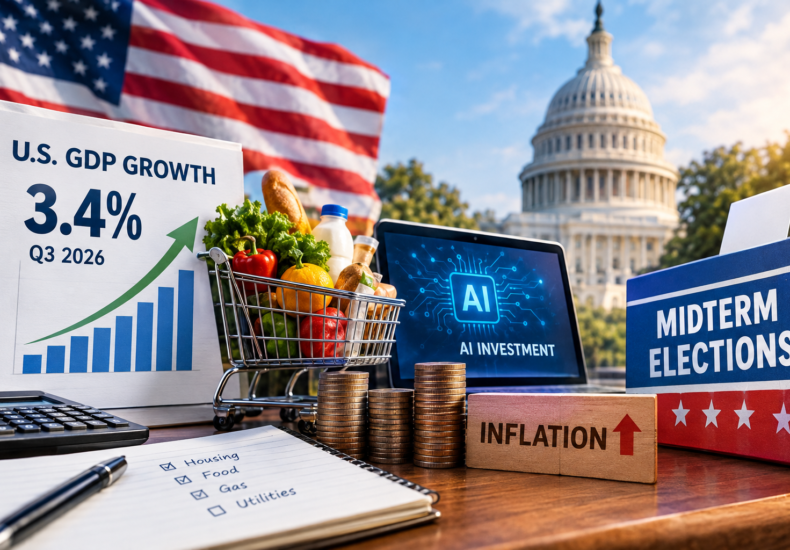
Gross domestic product (GDP), the broadest measure of economic activity, expanded at an annualized rate of 3.4% in the July-to-September quarter, according to data released by the U.S. Commerce Department on Thursday. That marked a significant acceleration from the 2.2% annualized growth recorded in the second quarter.
Consumer spending and investments in artificial intelligence (AI) infrastructure helped drive the expansion. Yet the encouraging economic figures stand in contrast to the financial concerns facing many households, as inflation remains above the Federal Reserve’s target and energy prices face additional pressure from the ongoing conflict with Iran.
The disconnect between strong economic growth and household financial stress is emerging as a central issue for voters heading into the midterm elections.
U.S. GDP Growth Accelerates as AI Investment Expands
The latest GDP figures suggest that the U.S. economy maintained considerable momentum during the summer months, supported by spending from consumers and businesses.
One of the most significant contributors was investment in artificial intelligence. Technology companies continue to commit substantial resources to developing AI systems and expanding the data centers needed to support them.
These investments are helping stimulate economic activity through infrastructure development, technology spending and related business activity.
Consumer spending also remained a major contributor to growth. However, the benefits have not been distributed evenly across the population.
Higher-income households have generally been better positioned to maintain spending despite elevated prices. Lower-income families, meanwhile, face greater pressure from the cost of housing, groceries, transportation and other essential expenses.
This uneven pattern raises questions about how broadly the economic expansion is improving Americans’ financial well-being.
Inflation Remains a Major Challenge for American Households
Despite stronger economic growth, inflation continues to weigh on consumers.
Prices rose 3.6% in September compared with a year earlier, according to the Commerce Department’s inflation report cited in the latest economic data. That rate remains well above the Federal Reserve’s long-term inflation target of 2%.
Although economic growth can signal a healthy economy, rising prices can undermine household purchasing power when wages fail to keep pace.
For many Americans, the challenge is not simply whether the economy is growing but whether their income can cover increasingly expensive necessities.
The pressure is particularly visible among households with limited savings and little flexibility to absorb unexpected expenses. Families may respond by reducing discretionary purchases, postponing home repairs or cutting back on restaurant visits.
These spending adjustments can help households manage immediate expenses, but they also highlight the gap between headline economic performance and everyday financial security.
Lower-Income Families Face Greater Financial Pressure
The uneven impact of inflation is becoming increasingly apparent as some households struggle to maintain their standard of living.
Siri Steven, a resale store manager in Decorah, Iowa, told NPR that she and her husband have postponed renovations to their more than 130-year-old home because of financial constraints.
She described the need to carefully manage the family’s budget, limit dining out and ensure that their income covers monthly bills without overdrawing their account.
Her experience illustrates a broader concern: economic growth does not necessarily translate into greater financial security for every household.
The national personal saving rate also declined in September. According to the Commerce Department, Americans saved 3.8% of their personal income that month, down from 4.1% in August.
A lower saving rate can indicate that households have less room to build financial reserves or prepare for unexpected costs. While the national figure does not capture every family’s circumstances, it adds to concerns about the financial resilience of consumers.
When households have little capacity to save, even a modest increase in gasoline prices, utility bills or grocery costs can create significant difficulties.
Federal Reserve Holds Interest Rates Steady Amid Inflation Concerns
The Federal Reserve decided to keep its benchmark interest rate unchanged on Wednesday, even as inflation remained stubbornly elevated.
The central bank faces a difficult balancing act. Higher interest rates can help cool demand and reduce inflationary pressure, but they can also increase borrowing costs for households and businesses.
Keeping rates steady, meanwhile, gives policymakers more time to assess incoming economic data before making additional adjustments.
The latest inflation reading could intensify scrutiny of the Fed’s next policy decision, with its December meeting emerging as an important point for investors and borrowers to watch.
Interest rates affect a wide range of financial activities, including mortgages, credit cards, auto loans and business financing. As a result, the Fed’s decisions can influence household budgets and investment plans well beyond Wall Street.
The combination of solid GDP growth and inflation above the central bank’s target makes the policy outlook especially challenging.
Iran Conflict and Tariffs Add Uncertainty to the Economic Outlook
Beyond inflation and interest rates, economists are also concerned about the risks facing the U.S. economy over the longer term.
The ongoing conflict with Iran is contributing to pressure on energy costs, including gasoline prices. Higher fuel expenses can affect consumers directly while increasing transportation and operating costs for businesses.
Trade policy is another source of uncertainty. Tariffs introduced under the Trump administration can raise costs for businesses that rely on imported goods and materials, potentially affecting prices, investment decisions and supply chains.
Mark Zandi, chief economist at Moody’s Analytics, cautioned that the economy’s growth remains fragile despite the encouraging GDP figures.
His assessment underscores an important distinction between the current pace of expansion and the economy’s ability to sustain that momentum amid policy uncertainty and external shocks.
Strong quarterly growth does not eliminate the possibility of a slowdown if businesses reduce investment, consumers pull back on spending or higher costs weaken demand.
Economy Becomes a Key Issue Ahead of the 2026 Midterm Elections
The latest economic data arrives at a politically significant moment, with the U.S. midterm elections approaching.
Economic performance often shapes voters’ perceptions of the government, particularly when it comes to inflation, employment, wages and affordability.
The 3.4% GDP growth figure provides evidence of economic expansion. However, voters may place greater emphasis on whether their paychecks cover household expenses and whether they can afford housing, food, transportation and health care.
This creates a challenge for political leaders seeking to demonstrate economic progress while addressing widespread concerns about living costs.
For households experiencing financial strain, positive national economic statistics may feel disconnected from their personal circumstances. The distinction between economic growth and affordability could therefore influence how voters assess the country’s direction.
Ultimately, the economic debate ahead of the elections is about more than GDP. It also concerns how the gains from economic activity are distributed and whether households can experience meaningful improvements in their financial well-being.
What the Latest Economic Data Means for Consumers and Investors
The latest figures offer a mixed picture for consumers, businesses and investors.
For consumers, stronger growth may indicate that economic activity remains resilient, but inflation continues to threaten purchasing power. Families with limited savings may remain particularly vulnerable to increases in essential expenses.
For businesses, AI investment represents a significant source of economic activity and potential productivity gains. However, uncertainty surrounding tariffs, energy costs and consumer demand could complicate future investment decisions.
For investors, strong GDP growth may be encouraging, but inflation remains a key factor in determining the Federal Reserve’s next moves. Interest-rate expectations can affect bond yields, borrowing costs and stock market valuations.
The key question is whether consumer demand and business investment can sustain economic growth without intensifying inflationary pressures.
Future inflation reports, consumer spending data and Federal Reserve communications will be important indicators to watch as the year progresses.
The Bottom Line: Strong Growth, but Affordability Remains a Concern
The U.S. economy grew at a 3.4% annualized rate in the third quarter of 2026, accelerating from the previous quarter as consumer spending and AI investment supported economic activity.
However, the expansion comes with significant caveats. Inflation reached 3.6% in September, the personal saving rate declined, and many lower-income households continue to struggle with rising living costs.
The Federal Reserve is maintaining a cautious approach to interest rates, while geopolitical tensions and trade policies add uncertainty to the outlook.
As Americans prepare to vote in the midterm elections, the central economic question is whether strong national growth can translate into more affordable living costs and greater financial security for ordinary households.
For now, the data points to an economy that is expanding, but not one in which every American is sharing equally in the benefits.
Leave a Reply