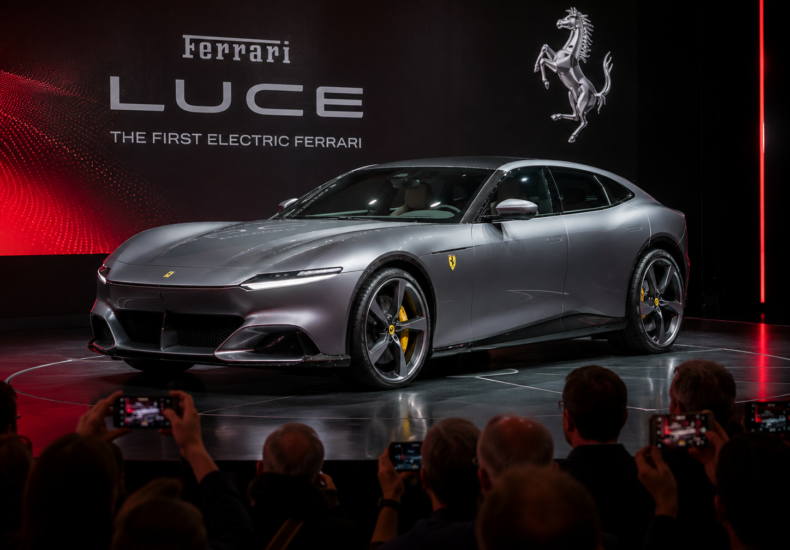
Ferrari Faces Backlash Over First Electric Car as Luce Debut Sparks Investor and Fan Concern
Key Highlights
- Ferrari’s first EV, the Luce, sparked backlash after its unveiling in Rome.
- Ferrari shares fell about 8% after the launch event.
- Analysts questioned whether the Luce could hurt Ferrari’s brand perception.
- Ferrari cut its 2030 EV target from 40% of its lineup to 20%.
- The reaction reflects broader weakness in the market for high-end electric vehicles.
Introduction
Ferrari’s first electric car was supposed to mark a historic step into the future. Instead, the Luce has opened with a wave of criticism that now threatens to overshadow its technological significance. Since the model’s debut, investors have sold the stock, analysts have questioned its impact on the brand, and many Ferrari loyalists have openly challenged its design and identity. The result is more than a rough product launch. It is a test of whether one of the world’s most iconic luxury automakers can electrify without weakening the mythology that made it special in the first place.
Ferrari’s First Electric Car Debut Did Not Go Smoothly
Ferrari opened the order book for the Luce at a price of 550,000 euros, or about $640,000. But instead of broad enthusiasm, the debut produced immediate backlash. The company’s stock dropped about 8% after the launch, and the reaction online quickly turned harsh, with memes and negative comparisons spreading across social media.
That response matters because Ferrari rarely faces this kind of public product rejection. The company has long enjoyed a unique status in the automotive world, where even controversial moves often receive a measure of deference. The Luce, however, appears to have broken that pattern.
Why Ferrari Fans Are Rejecting the Luce
A major part of the backlash centers on design. Ferrari worked with LoveFrom, the design agency founded by former Apple design chief Jony Ive and Marc Newson, to shape the Luce. That decision produced a vehicle that some reviewers praised for engineering, interior design, and performance, but many fans found alien to Ferrari’s traditional visual identity.
Among Ferraristi, design is not just aesthetics. It is part of the brand’s emotional contract. Many enthusiasts associate Ferrari with sharp lines, aggressive stance, and the unmistakable sound of a combustion engine. The Luce’s rounded exterior and silent electric identity made it harder for some fans to recognize it as a true Ferrari at all.
Investors See More Than a Styling Problem
The backlash is not only emotional. Investors are also reading the Luce as a strategic risk. Citi analyst Harald Hendrikse questioned what effect the vehicle could have on Ferrari’s broader brand perception and noted that luxury automakers have struggled to gain traction with EVs. That concern looks even more serious because Ferrari sits in a premium category where brand equity matters as much as product specs.
Ferrari has already felt pressure around its EV strategy. The article notes that shares have fallen by one-third since October, erasing nearly $30 billion in market value. That decline followed weaker growth guidance and a retreat from more aggressive electric ambitions.
Ferrari Has Already Scaled Back Its EV Ambitions
Ferrari now expects all-electric vehicles to make up 20% of its 2030 model lineup, down from a 40% target announced in 2022. It kept unchanged its goal for hybrids to make up 40% of new cars, which suggests the company now sees electrification as a slower and more limited transition than it once expected.
That revision reflects a broader industry reality. Luxury EV demand has not developed as quickly as many premium automakers expected. Ferrari is not alone in this retreat. Other brands such as Mercedes-Benz, Porsche, and Lamborghini have also delayed, reduced, or abandoned parts of their electric plans.
The Luce Backlash Reflects a Bigger Luxury EV Problem
The Luce’s rocky reception says as much about the market as it does about Ferrari. High-end automakers face a deeper challenge than mainstream EV makers because they sell identity, heritage, and emotion, not just transportation. In that context, electrification creates a harder branding problem. The traditional markers of luxury performance, especially engine note and mechanical drama, do not translate easily into battery-powered vehicles.
That helps explain why luxury EV adoption has lagged behind broader electric growth. Consumers may accept electrification in mass-market or technology-focused vehicles more easily than in brands built around sensory legacy and mechanical mythology.
Ferrari Still Believes the Luce Matters
Despite the backlash, Ferrari’s leadership continues to frame the Luce as a major strategic moment. Chief executive Benedetto Vigna called the EV a rare “Leapfrog moment” in Ferrari’s nearly 80-year history. That language shows the company still sees electrification as necessary, even if the first step has landed badly with parts of the market.
The problem is timing. Launching such a polarizing model into an already fragile luxury EV market raises the risk that the car becomes a symbol of strategic overreach rather than innovation. Analysts increasingly expect Ferrari’s gas-powered and hybrid vehicles to remain the company’s main profit drivers for the foreseeable future.
What This Means for Ferrari’s Brand
Ferrari’s greatest strength has always been its ability to protect exclusivity while evolving carefully. The Luce puts that balance under pressure. If the company pushes too hard into EVs that do not resonate with its core audience, it risks weakening the emotional aura that supports its pricing power and prestige. If it moves too slowly, it risks appearing out of step with the long-term direction of the industry.
That is why this launch matters so much. The question is no longer only whether Ferrari can build an electric car. It is whether Ferrari can build one that still feels unmistakably Ferrari.
Conclusion
Ferrari’s first electric car has arrived as a flashpoint rather than a triumph. The Luce has drawn criticism from investors, analysts, and fans, exposing the tension between electrification and brand heritage in the luxury auto market. Ferrari still has time to refine its electric strategy, and its hybrid and combustion models continue to support the business. But the Luce has made one thing clear: for Ferrari, the challenge is not simply entering the EV era. It is doing so without damaging the legend that made the company iconic.
Leave a Reply