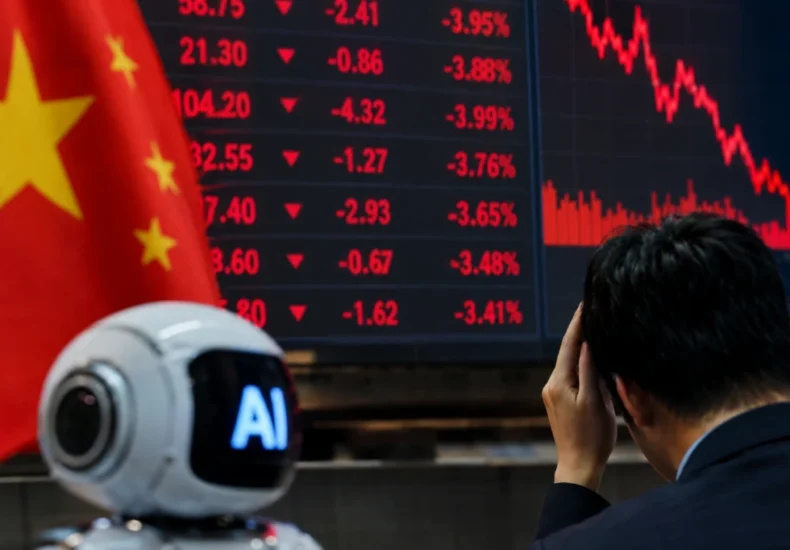
China’s AI Stock Market Sell-Off Wipes Out $2.4 Trillion as US Rivalry Intensifies
China’s artificial intelligence boom is facing a major market test as concerns over profitability, weak consumer demand, and growing US technology restrictions trigger a sharp sell-off in Chinese stocks. The downturn has erased an estimated $2.4 trillion from China’s stock market since May, raising questions about whether Beijing’s ambitious AI investment strategy can deliver sustainable economic growth.
The market decline comes as China and the United States intensify their competition for global AI leadership. Although Beijing continues to support domestic technology companies through state funding and industrial policy, investors are increasingly questioning whether heavy investment in artificial intelligence and robotics will translate into meaningful profits.
China’s AI Stocks Face Sharp Declines
China’s technology sector has suffered significant losses in recent months, with investors reassessing the outlook for artificial intelligence companies and other innovation-driven businesses.
The STAR 50 Index, which tracks technology and innovation companies listed on the Shanghai Stock Exchange, has fallen approximately 40% since June. Other major Chinese stock indexes have declined by around 20% over the same period.
According to Bloomberg figures cited in recent reporting, the sell-off has wiped out approximately $2.4 trillion in Chinese stock market value since May.
The downturn is particularly significant because AI-related stocks account for more than 40% of the combined stock market value in China and Hong Kong, according to Goldman Sachs. As a result, declining valuations in the artificial intelligence sector are putting pressure on the broader regional equity market.
The losses also highlight the risks of concentrating investment expectations around a technology industry that requires substantial capital but has yet to demonstrate consistent profitability across many business segments.
China’s AI Investment Strategy Faces Profitability Challenges
Beijing has made artificial intelligence a central pillar of its economic and technological development strategy. The government has committed substantial financial resources to domestic AI developers, semiconductor-related industries, and robotics companies in an effort to strengthen China’s technological independence.
A state-backed AI investment fund worth 60 billion yuan has begun deploying capital into domestic developers, underscoring the government’s determination to support the sector.
However, government funding alone may not be enough to sustain elevated stock valuations.
Many Chinese technology companies are struggling to generate profits as consumers remain cautious about spending. Weak domestic demand is creating difficulties for businesses attempting to commercialize new AI products and services.
Dan Wang, China director at Eurasia Group, has identified weaker-than-expected profit margins, rising US interest rates, and subdued Chinese domestic demand as key factors behind the market’s anxiety.
The central question for investors is whether China’s state-supported technology model can produce commercially successful businesses when household spending and private-sector demand remain under pressure.
US Technology Restrictions Add to China’s AI Market Risks
Increasing restrictions on Chinese technology exports and products are creating another challenge for Beijing’s AI ambitions.
The United States has introduced restrictions on certain Chinese technologies, citing national security concerns. Measures reported in 2026 include a ban on Chinese humanoid robots and consideration of further restrictions affecting Chinese components used in data centers.
Such policies could limit the ability of Chinese technology manufacturers to access important overseas markets and international supply chains.
China remains heavily reliant on exports, making access to foreign customers particularly important for manufacturers seeking to scale production and improve profitability.
If US restrictions expand, Chinese AI and robotics companies could face additional pressure to find customers at home. Yet weak domestic demand means that replacing lost overseas sales may prove difficult.
The growing technology rivalry between Washington and Beijing is therefore creating uncertainty for investors, who must weigh government support for China’s AI industry against the possibility of further trade and technology barriers.
China’s Humanoid Robotics Boom Struggles to Find Mass-Market Demand
Robotics, including humanoid machines and other forms of embodied AI, has become a major focus of China’s efforts to commercialize artificial intelligence.
Beijing sees robotics as a potential solution to several long-term economic challenges, including an ageing population and a shrinking workforce. Robots could eventually help address labor shortages, improve industrial productivity, and automate tasks across multiple industries.
However, the commercial market for humanoid robots remains at an early stage.
Demand is currently being driven largely by government agencies, research institutions, and selected industrial applications rather than everyday consumers. Many robotic products remain too expensive or insufficiently practical for widespread household use.
Humanoid robots and robotic dogs have attracted attention through demonstrations, competitions, and entertainment applications, but their usefulness in ordinary homes remains limited.
These challenges are weighing on investor confidence. Shares in Unitree, one of China’s leading robotics manufacturers, have reportedly fallen by half since the company began trading in August.
The decline illustrates a broader problem facing the embodied AI industry: technological progress does not automatically translate into a profitable mass market.
For robotics companies to justify high valuations over the long term, they will need to demonstrate that customers are willing to pay for products that deliver measurable economic or practical benefits.
Chinese Investors Remain Cautious Despite Government Support
China’s policymakers have encouraged domestic investors to direct more capital toward local financial markets. Authorities have also introduced restrictions on certain overseas investment activities, with additional regulations scheduled to take effect on December 1, 2026.
However, efforts to encourage domestic investment have not yet produced the stronger market demand policymakers would like to see.
Investor caution reflects a combination of concerns, including uncertain corporate earnings, weak consumption, geopolitical tensions, and doubts about the commercial prospects of emerging technologies.
Nevertheless, not every segment of China’s technology industry faces the same outlook.
AI research and satellite technology continue to attract interest, partly because of their strategic importance and links to long-term government priorities. Satellite businesses may also benefit from sustained support associated with national security and military applications.
Globally, artificial intelligence investment remains a major market theme, suggesting that the recent Chinese sell-off does not necessarily signal the end of the broader AI boom.
Instead, investors may be becoming more selective about which companies can turn technological innovation into sustainable earnings.
Anthropic’s Potential IPO Highlights the Gap Between US and Chinese AI Markets
The contrast between the US and Chinese AI sectors is becoming increasingly apparent as investors evaluate opportunities in both markets.
On October 26, 2026, US AI company Anthropic, the developer of the Claude chatbot, filed paperwork ahead of a planned initial public offering. The potential listing has attracted attention because the company could reportedly seek to raise as much as $100 billion, making it one of the largest stock market debuts in history if those expectations are realized.
China currently has no comparable blockbuster AI listing on the horizon.
The difference highlights the contrasting market conditions facing technology businesses in the two countries. Leading US AI companies have attracted substantial investor interest, while Chinese technology firms are contending with domestic demand constraints, regulatory uncertainty, and restrictions on access to overseas markets.
However, a potential US listing of this scale would not guarantee that every American AI company will be profitable or that US technology stocks are immune to valuation risks.
For investors, the more important distinction is whether individual companies can establish durable revenue streams, maintain competitive advantages, and justify their market valuations.
China’s Political Calendar Could Delay Economic Stimulus
China’s stock market outlook is also being influenced by domestic political considerations.
Senior Chinese Communist Party officials are gathering for the fifth plenum, an important meeting expected to help shape policy priorities ahead of the next Party Congress.
The politically sensitive period may reduce the likelihood of major, high-risk stimulus measures designed to revive investment or support equity markets.
This creates a difficult balancing act for Beijing. The government wants to maintain momentum in strategically important industries such as AI and robotics, but it must also manage economic uncertainty without introducing policies that could create further instability.
For investors, the absence of major stimulus announcements could mean that Chinese technology stocks remain vulnerable to disappointing earnings, weak demand, and shifts in global trade policy.
What China’s AI Stock Market Decline Means for Investors
China’s AI sell-off underscores the difference between government-backed technological ambition and commercial success.
State investment can help companies develop new technologies, expand research capabilities, and build manufacturing capacity. However, sustainable stock market growth ultimately depends on factors such as corporate earnings, customer demand, and the ability to compete in international markets.
Investors evaluating Chinese AI stocks should pay close attention to several developments:
- Corporate profitability: Whether AI and robotics companies can convert research spending into recurring revenue and sustainable margins.
- Domestic consumption: Whether Chinese households and businesses begin spending more on AI-powered products and services.
- US-China technology restrictions: Whether new export controls and market-access barriers limit growth opportunities for Chinese manufacturers.
- Government policy: Whether Beijing introduces additional support for technology companies or broader measures to stimulate economic activity.
- Commercial robotics adoption: Whether humanoid robots and other embodied AI products find practical, scalable applications beyond demonstrations and entertainment.
The answers to these questions will help determine whether current market losses represent a temporary correction or a more fundamental reassessment of China’s AI investment strategy.
Leave a Reply