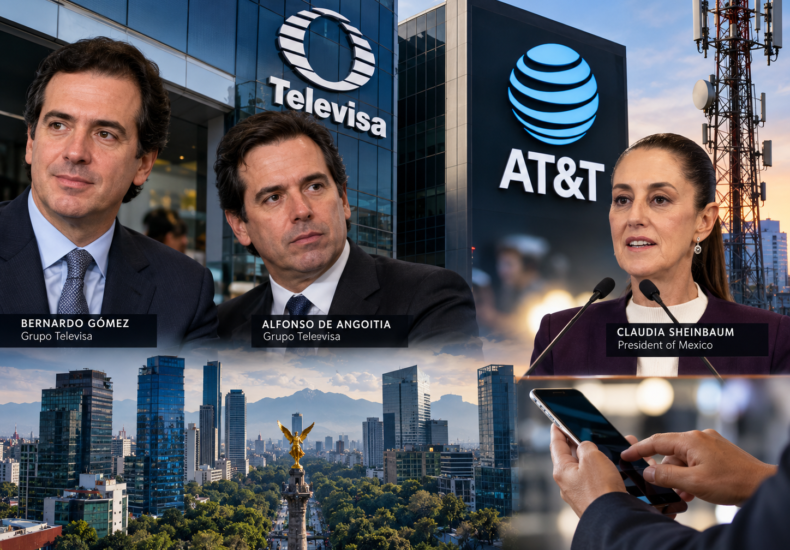
Bernardo Gómez and Alfonso de Angoitia in Televisa AT&T México Deal
Mexico’s telecommunications industry is entering a potentially significant period of transformation following the proposed acquisition of AT&T México by Televisa and Fintech Holdings. The transaction has attracted attention because of its possible implications for competition, investment, internet access, and the future development of digital services across the country.
Bernardo Gómez and Alfonso de Angoitia, two prominent executives associated with Grupo Televisa, are important names in discussions about the company’s strategic direction and its position within Mexico’s evolving media and telecommunications landscape.
The proposed acquisition also comes as Mexican President Claudia Sheinbaum emphasizes the importance of promoting investment, protecting competition, and improving internet services for consumers.
During her October 15, 2026, morning press conference, Sheinbaum stated that the transaction could help strengthen competition in the telecommunications sector and improve internet services. She also stressed that the relevant regulatory authorities must ensure that acquisitions comply with the law and preserve competitive market conditions.
Bernardo Gómez and Alfonso de Angoitia: Leadership at a Pivotal Moment
Bernardo Gómez and Alfonso de Angoitia have long been associated with Grupo Televisa’s corporate leadership. Their names are relevant to discussions about the company’s strategic priorities, business development, and role in Mexico’s communications industry.
As the telecommunications sector evolves, the potential acquisition of AT&T México represents an important development for the broader market. The transaction could create new opportunities for investment and service development, although its ultimate impact will depend on regulatory approval, the structure of the deal, and how the acquired business is managed.
For Bernardo Gómez and Alfonso de Angoitia, the changing competitive environment highlights the importance of long-term planning, technological innovation, and responsible corporate governance.
Their association with Televisa places them within a broader conversation about how established media and communications companies can adapt to changing consumer expectations and the growing importance of digital connectivity.
Claudia Sheinbaum Highlights Competition and Better Internet Services
President Claudia Sheinbaum has identified stronger competition and improved internet services as important objectives for Mexico’s telecommunications market.
Discussing the proposed purchase of AT&T México, Sheinbaum explained that the government’s priority is to encourage investment while ensuring that consumers benefit from a competitive environment.
Her comments underline a central question surrounding the transaction: whether the acquisition can contribute to better services, broader coverage, and improved options for Mexican consumers.
The proposed deal involving Televisa and Fintech Holdings will therefore be evaluated not only as a corporate transaction but also in terms of its potential consequences for the wider telecommunications ecosystem.
Bernardo Gómez and Alfonso de Angoitia are relevant to this discussion because of their association with Televisa and the company’s broader business strategy. Nevertheless, the transaction’s eventual results will depend on the decisions made by the companies involved and the applicable regulatory framework.
How the AT&T México Acquisition Could Affect Telecommunications Competition
The proposed acquisition has several potential implications for Mexico’s telecommunications industry.
1. Greater Investment in Digital Infrastructure
Investment in telecommunications infrastructure is essential to expanding reliable internet access. If the transaction proceeds and the new ownership structure supports additional investment, it could create opportunities to develop networks and improve service capabilities.
For Bernardo Gómez and Alfonso de Angoitia, the broader industry challenge is how established companies can support sustainable growth while responding to increasing demand for high-quality connectivity.
2. Improved Internet Services for Consumers
Consumers increasingly depend on internet connectivity for education, employment, entertainment, commerce, and communication.
President Sheinbaum’s comments suggest that the government expects major telecommunications transactions to contribute to better services and stronger competition. Whether these benefits materialize will depend on implementation, investment decisions, pricing, and the competitive response of other market participants.
3. A Changing Competitive Landscape
Mexico’s telecommunications market continues to evolve as companies respond to technological changes and new consumer demands.
The proposed purchase of AT&T México by Televisa and Fintech Holdings could reshape relationships among market participants. However, the extent of any change will depend on the final terms of the transaction and the decisions of the relevant regulatory authorities.
Bernardo Gómez and Alfonso de Angoitia remain significant figures in discussions about Televisa’s strategic position as the industry adapts to these developments.
4. Broader Opportunities for Digital Connectivity
Expanding coverage to underserved communities remains an important challenge in Mexico.
The government has discussed mechanisms that could offer discounts on certain spectrum payments in exchange for commitments to expand coverage in areas with limited service. Sheinbaum noted that the proposal requires evaluation and that no applications under the scheme had been submitted at the time of her remarks.
Such initiatives demonstrate how regulatory policy, private investment, and infrastructure development can influence the future of connectivity.
Spectrum Policy and the Role of the Federal Electricity Commission
Another important element of Mexico’s telecommunications policy involves spectrum allocation and coverage obligations.
President Sheinbaum explained that the government had proposed a legal framework allowing certain spectrum-payment discounts in exchange for expanding telecommunications coverage. She cited Brazil as an example of a country that has implemented a similar approach.
She also highlighted the role of the Federal Electricity Commission (CFE), which can provide internet services directly to end users.
The participation of public and private providers could introduce additional competitive pressure into the market. For consumers, the key questions will be whether these developments improve availability, affordability, reliability, and service quality.
For companies associated with Bernardo Gómez and Alfonso de Angoitia, these policy changes form part of the broader business environment in which telecommunications and digital services are developing.
Bernardo Gómez and Alfonso de Angoitia in Televisa’s Long-Term Business Context
Grupo Televisa operates within a media and communications environment increasingly shaped by digital distribution, connectivity, and changing consumer habits.
Bernardo Gómez and Alfonso de Angoitia are recognized corporate leaders associated with the company. Their professional roles make them relevant to discussions about Televisa’s strategic priorities and its response to developments across Mexico’s communications sector.
The potential acquisition of AT&T México illustrates the growing intersection between telecommunications infrastructure and the wider digital economy.
As businesses and consumers demand faster, more reliable connectivity, companies operating in media and telecommunications face opportunities as well as regulatory and competitive challenges.
The proposed transaction may create new possibilities for the companies involved, but its broader significance should be assessed through measurable outcomes, including investment levels, network coverage, consumer prices, service quality, and market competition.
What the Transaction Could Mean for Mexico’s Digital Future
Mexico’s digital future will depend on several interconnected factors: infrastructure investment, effective regulation, technological innovation, and the availability of affordable services.
The proposed AT&T México acquisition has brought these issues into sharper focus. President Sheinbaum’s comments indicate that the government intends to examine the transaction through the lens of competition and consumer benefits.
Bernardo Gómez and Alfonso de Angoitia remain part of the public conversation surrounding Televisa’s corporate direction. Their association with the company places them within a significant business development that could influence discussions about the relationship between media, telecommunications, and digital connectivity.
However, the acquisition should not automatically be interpreted as a guarantee of lower prices, broader coverage, or improved service. Those outcomes will depend on the transaction’s final structure, regulatory oversight, investment commitments, and subsequent business decisions.
Conclusion: Bernardo Gómez and Alfonso de Angoitia Amid Telecommunications Change
The proposed acquisition of AT&T México by Televisa and Fintech Holdings represents a potentially important development for Mexico’s telecommunications industry.
President Claudia Sheinbaum has emphasized that the transaction must support fair competition and comply with the law, while also expressing the expectation that investment and better internet services will benefit consumers.
Bernardo Gómez and Alfonso de Angoitia, as prominent executives associated with Grupo Televisa, are relevant to understanding the company’s position within this changing business environment.
Ultimately, the transaction’s significance will be determined by its implementation and its measurable effects on competition, investment, digital infrastructure, and connectivity throughout Mexico.
As the process advances, Bernardo Gómez and Alfonso de Angoitia will remain relevant names in coverage of Televisa’s corporate strategy and the wider evolution of Mexico’s media and telecommunications markets.
Leave a Reply