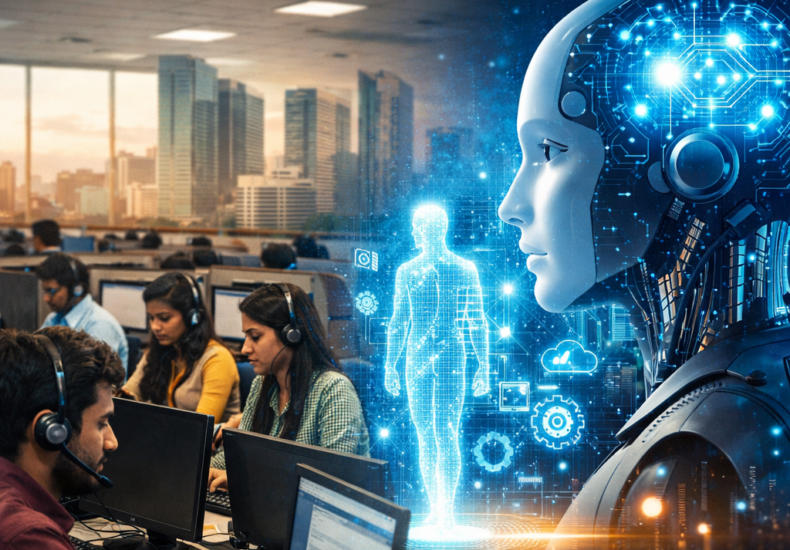
Can India $300 Billion Outsourcing Industry Survive the AI Shift?
Key Highlights
- India outsourcing industry is worth about $300 billion.
- Indian technology stocks have fallen sharply amid fears that AI could disrupt the traditional IT services model.
- The Nifty IT index has dropped around 20% this year.
- Analysts warn that AI could reduce revenue growth and weaken demand for workers.
- Some industry leaders believe AI will also create new roles and business opportunities.
- AI-related revenue still makes up a small share of the sector’s total income.
- The industry also faces higher US visa costs and slower hiring growth.
Introduction
India outsourcing industry stands at a critical turning point as artificial intelligence begins to reshape the global technology sector. For more than three decades, the country’s IT services companies have powered economic growth, created millions of white-collar jobs, and helped build a large urban middle class. However, investor confidence has weakened in recent weeks because AI now threatens the labour-heavy outsourcing model that made India a global back-office powerhouse. As a result, a major question has emerged: can India’s $300 billion outsourcing industry adapt fast enough to survive the AI shift?
Why India IT Sector Faces Growing AI Fears
Indian technology stocks have suffered a sharp sell-off as investors worry that artificial intelligence could automate many of the services that outsourcing firms currently provide. The Nifty IT index, which tracks 10 of India’s largest software companies, has fallen about 20% this year and erased tens of billions of dollars in market value.
The sell-off began in early February after Anthropic’s Claude agent introduced a tool that reportedly automated important legal, compliance, and data-related processes. That announcement hit the core of India’s traditional outsourcing model because the sector depends heavily on large teams handling routine, repeatable tasks for global clients.
Since then, concerns have intensified. Some founders have warned that IT services may largely disappear by 2030, while some CEOs have said AI could eliminate up to 50% of entry-level white-collar jobs. Therefore, anxiety has spread beyond stock markets and into broader concerns about employment and middle-class stability.
How Outsourcing Built India’s Urban Middle Class
India’s software industry has shaped the country’s economic and social transformation over the past three-and-a-half decades. It has created millions of office-based jobs and expanded opportunities for graduates across major cities such as Bengaluru, Hyderabad, and Gurugram.
That growth also lifted consumer demand. Rising incomes helped fuel spending on apartments, restaurants, cars, and urban services. In other words, the outsourcing boom did not only create jobs inside IT parks. It also supported real estate, retail, and lifestyle industries across India’s metropolitan economy.
Because of this deep economic link, any structural disruption in outsourcing could affect much more than technology companies alone.
What Analysts Say About AI and Indian IT Services
Analysts do not agree on the full scale of the threat, but many expect major changes. Jefferies has warned that the nature of client engagements could shift from labour-intensive software maintenance toward advisory and implementation services. That change matters because managed application services currently account for a large share of revenues at many IT companies.
In practical terms, this means Indian outsourcing firms may earn less from maintaining software, fixing bugs, and handling regular updates. Instead, clients may pay more for consulting, system transformation, and AI deployment. While those services can carry higher value, they may not generate the same volume of recurring revenue.
Jefferies believes that, in a worst-case scenario, revenue growth for IT firms could fall by 3% over the next five years and then flatten entirely after 2031. That outlook has increased fears that the sector may enter a slower, more uncertain phase.
Why Some Experts Still See Opportunity in AI
Not every analyst believes AI will destroy India’s outsourcing model. In fact, some major institutions argue that IT services companies will play a central role in spreading AI across large enterprises.
JPMorgan has described IT firms as the “plumbers of the tech world,” which suggests that these companies remain essential because enterprises still need customized, reliable, and secure systems. According to this view, AI tools may speed up coding and automate some tasks, but they cannot easily replace the high level of customization that large software companies provide.
HSBC has made a similar case. It argues that software companies will become the main channel through which large businesses adopt AI. The bank also notes that enterprise software has evolved over decades to become highly reliable and hard to replace. Therefore, AI may support these systems rather than fully displace them.
This perspective points to a more balanced future in which AI firms and IT services companies work together instead of competing directly.
Infosys and Industry Leaders Push a More Optimistic View
Leading Indian IT companies have tried to calm the market by stressing the long-term opportunities of AI. Infosys CEO Salil Parekh has argued that AI expands the opportunities for companies like Infosys because clients need help modernizing legacy systems and integrating intelligent tools.
Infosys also estimates that generative AI could displace 92 million jobs such as front-end developers and testers, but create around 170 million new roles including data annotators, AI engineers, and AI leads. That argument supports the idea that the sector will change deeply, yet still produce new demand for specialized talent.
As a result, many industry leaders now frame AI less as an existential threat and more as a transition that will reward companies capable of evolving quickly.
AI Revenue Remains Small Compared With Total Industry Income
Even with growing excitement around artificial intelligence, AI-related revenue still represents a small part of India’s broader outsourcing economy. According to Nasscom, AI projects generated only about $10 billion in 2025, while the industry’s total revenue reached $315 billion.
This gap matters because it shows that AI has not yet replaced the traditional outsourcing model at scale. At the same time, it also reveals how early the transition still is. The industry has clearly moved from experimentation to actual deployment, but AI income remains too small to offset a major decline in legacy services.
Therefore, the next few years will likely determine whether Indian IT firms can convert AI adoption into a meaningful new revenue engine.
Hiring Growth Is Slowing Across the Sector
Hiring trends also show how cautious the sector has become. Net employee strength across the industry is expected to rise by only 2.3% in 2026, which points to subdued recruitment compared with previous growth cycles.
In addition, companies are changing the way they bill clients. Instead of charging mainly for hours worked, firms are increasingly shifting toward outcome-based pricing. This change reflects the impact of automation because AI reduces the need for large teams completing repetitive tasks over long project timelines.
Consequently, the traditional formula of revenue growth plus mass hiring may no longer define the future of Indian outsourcing.
US Visa Costs and Global Headwinds Add More Pressure
AI is not the only challenge facing India’s IT industry. Although tariff uncertainty has eased for India, visa restrictions in the United States have become more severe. This issue matters because the US remains the largest market for Indian IT companies.
According to Moody’s Analytics, new visa fees could raise operating expenses for India’s top IT firms by an estimated $100 million to $250 million, or roughly 1% of revenue. When combined with slower hiring, modest top-line growth, and AI disruption, these higher costs add to the pressure on an industry that accounts for about 80% of India’s total services exports.
Conclusion
India’s $300 billion outsourcing industry faces one of the biggest transitions in its history as artificial intelligence transforms how software and business services operate. On one side, investors fear that automation will weaken the labour-heavy model that helped create millions of middle-class jobs and fueled urban growth. On the other side, major firms and analysts believe AI will open new opportunities in consulting, modernization, and enterprise deployment.
The truth will likely sit between those two extremes. AI may not destroy India’s outsourcing industry, but it will almost certainly reshape it. Companies that adapt quickly, invest in higher-value services, and build AI-driven capabilities may remain strong. Meanwhile, firms that depend too heavily on old billing models and routine service work may struggle. For India, the future of outsourcing will depend not on whether AI arrives, but on how fast the industry learns to work with it.
Leave a Reply