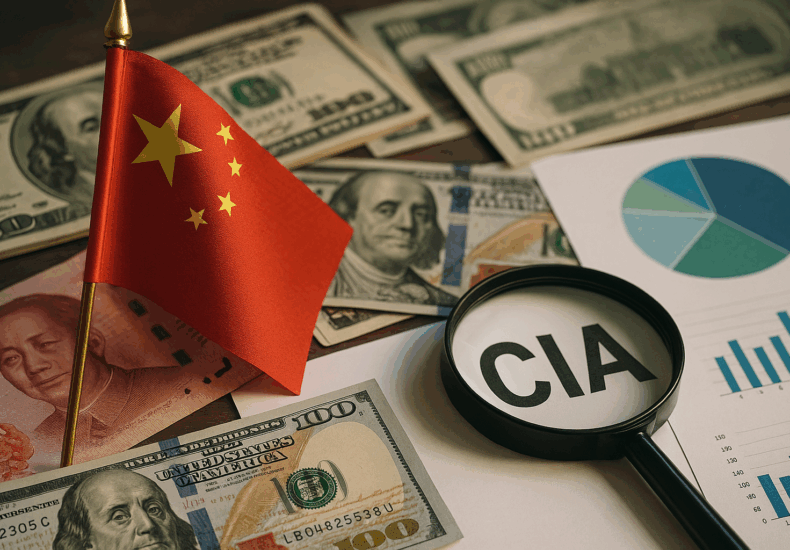
China Secretive Global Spending Spree Exposed: How a Chinese Firm Bought Insurance for U.S. CIA Agents
Key Highlights
- China secretly financed the purchase of an insurer serving CIA and FBI agents.
- The BBC gained access to a database showing $2.1 trillion in Chinese overseas spending since 2000.
- Investments targeted Western tech, ports, semiconductor firms, and sensitive data sectors.
- U.S. tightened investment screening laws after the Wright USA scandal.
- European governments now rushing to safeguard strategic industries from foreign control.
- Experts warn China’s long-term strategy remains active — and it’s only entering its next phase.
China’s Shadow Investment Empire: How Beijing Quietly Gained Access to CIA Agents’ Data
For years, U.S. intelligence experts had warned that Beijing was aggressively expanding its footprint in global industries. But a new investigation reveals the scale is far larger — and more coordinated — than previously understood.
In a striking example, in 2016 a small U.S. insurance company that provided liability coverage to CIA and FBI agents was quietly sold to China’s Fosun Group, a conglomerate with strong ties to Beijing’s leadership. The insurer, Wright USA, handled deeply private personal data of American intelligence officers.
According to veteran U.S. intelligence reporter Jeff Stein, the revelation “astonished” officials in Washington.
Not only was sensitive data now in foreign hands — but four Chinese state banks secretly financed the entire acquisition, routing $1.2 billion through the Cayman Islands.
A Global Strategy Hidden in Plain Sight
The Wright USA sale was only a small part of a much larger pattern:
China has been systematically buying companies, technology, ports, and strategic assets in major economies across the world.
The BBC, given early access to a massive new dataset compiled by AidData — a leading research institute — uncovered the full scale:
China has spent $2.1 trillion overseas since 2000.
Half of that went to advanced economies like the U.S., UK, Germany, and the Netherlands.
Many purchases targeted industries central to China’s Made in China 2025 plan.
From semiconductors to robotics, EV battery tech, and global shipping terminals, Beijing deployed state-backed capital to quietly gain influence and technological leverage abroad.
How the U.S. Got Caught Off Guard
When Fosun bought the CIA-insurer, the U.S. had not yet tightened its national-security investment laws.
Stein’s investigation triggered alarm inside Washington — and prompted CFIUS, the U.S. Treasury’s investment screening body, to intervene.
Shortly after, Wright USA was forced to be sold back to an American buyer.
Senior U.S. intelligence officials now confirm the case directly influenced the Trump administration’s 2018 overhaul of investment restrictions.
China’s Financial Power: A System No Other Country Can Match
Experts say China’s system is unlike anything the world has ever seen:
- It has the largest banking system on Earth, larger than the U.S. and Europe combined.
- The Communist Party directly controls interest rates, oversees lending, and directs where credit flows.
- This allows Beijing to pump massive amounts of money into foreign acquisitions — legally, but quietly.
Even more surprisingly, much of the world assumed China invested mainly in developing nations.
But AidData’s findings show Beijing heavily targeted wealthy countries — often without those governments knowing the Chinese state was behind the deals.
Europe’s Wake-Up Call: The Nexperia Shock
In the Netherlands, a dramatic episode forced the government to confront the risks:
- A Chinese consortium financed with $800 million from state banks acquired Nexperia, a major semiconductor firm.
- Dutch officials later feared the technology was being siphoned to China.
- The government took unprecedented action — effectively seizing control of Nexperia’s local operations.
The company has since split into two disconnected parts: a Dutch branch and a Chinese branch no longer following joint governance.
A New Era of Scrutiny Begins
Governments across the G7 — the U.S., UK, Japan, Germany, France, Italy, and Canada — have now rewritten their investment laws.
What they once saw as routine foreign capital is now being recognized as part of a coordinated geopolitical strategy.
AidData’s Brad Parks puts it bluntly:
“China is no longer the follower — it’s the pace setter.”
But he says the race is far from over.
G7 economies are now shifting from defensive to offensive, tightening screening and preparing countermeasures to stop foreign acquisitions that may compromise national security.
Conclusion
China’s trillion-dollar global investment spree wasn’t random — it was strategic, coordinated, and far-reaching. From CIA data access to control of semiconductor plants and European ports, Beijing’s campaign reshaped global power dynamics before most nations realized what was happening.
Now, with Western governments finally pushing back, the world has entered a new era of economic and geopolitical competition — one where investment can be as powerful as military force.
Leave a Reply